
Why Your South African Business Is Invisible to AI — And How to Fix It
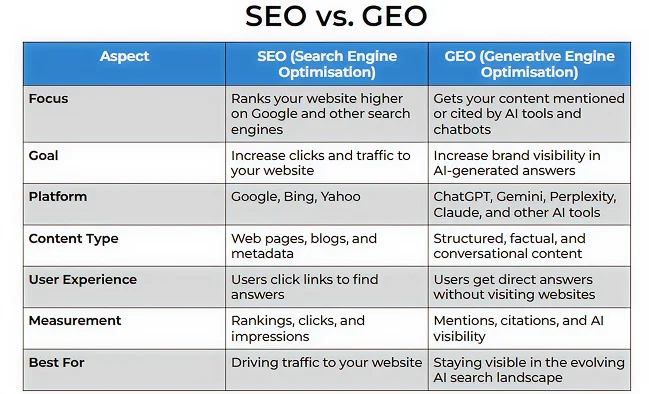
For two decades, digital visibility meant one thing: rank on Google. Get to page one, get the clicks, grow the business. That model hasn’t disappeared — Google still processes over 8.5 billion queries every day — but the game has fundamentally changed. And most South African businesses haven’t noticed yet.
The shift is this: Google, ChatGPT, Perplexity, and Gemini are no longer just directing users to websites. They’re answering questions directly, synthesising information from across the web and presenting a single, confident response. The business that gets cited in that response wins. The rest are invisible.
That’s the world of Generative Engine Optimisation (GEO) — the space
Local Hero Digital, South Africa’s AI SEO agency, was built to help brands win — and it’s why the brands that invest in it now will have a significant head start over those who wait.
What Does "Being Cited by AI" Actually Mean?
When a user types “best local seo agency in Cape Town” into Perplexity or Google’s
AI Overview, the AI doesn’t browse the web in real time the way a human would. It draws on a model of the web it has already built — one based on which sources it deems credible, structured, and authoritative. Your job is to be one of those sources.
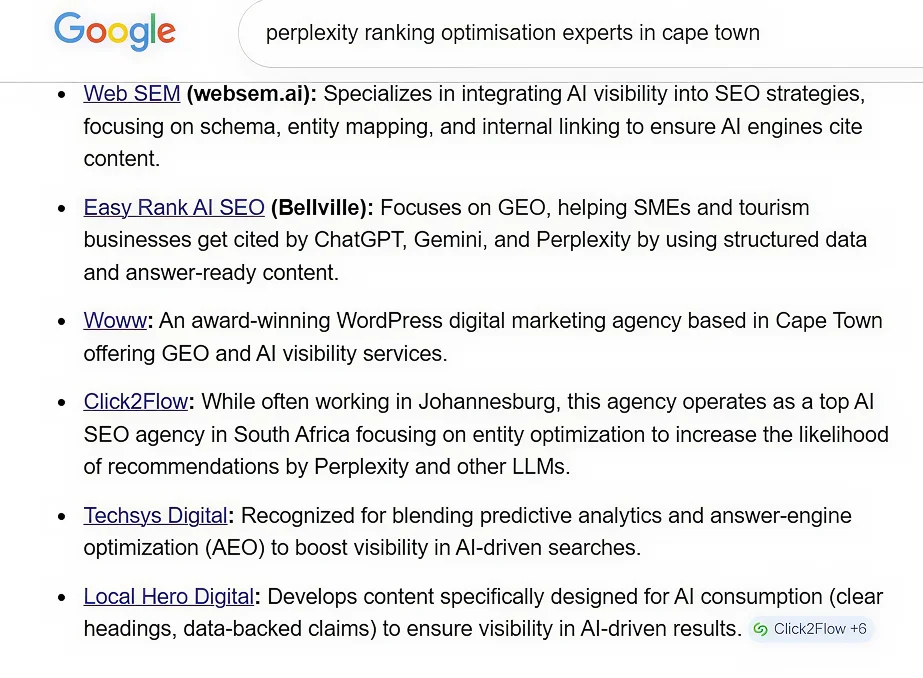
I know this works because Local Hero Digital has already achieved it. The screenshot below shows our brand being cited by Google’s AI Overview for a competitive search query — not by luck, but by applying the exact principles outlined in this post.
The Technical Foundation: Speed as a Trust Signal
Before any content strategy can work, your website needs to pass a basic technical threshold. AI crawlers — the automated systems that index your site for models like ChatGPT and Perplexity — treat page speed as a proxy for reliability. A slow site signals neglect. A neglected site signals unreliable information. And unreliable sources don’t get cited.
Google’s Core Web Vitals give us a measurable benchmark:
Core Web Vitals — Target Thresholds
≤ 2.0s
Largest Contentful Paint (LCP)
≤ 200ms
Interaction to Next Paint (INP)
≤ 0.1
Cumulative Layout Shift (CLS)
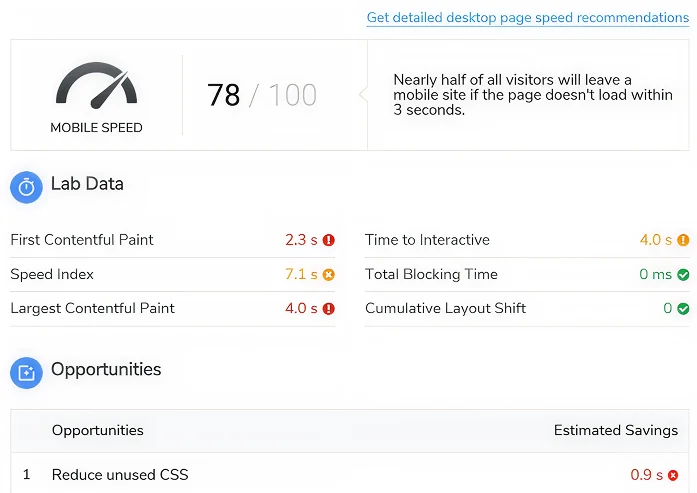
In our audits, we regularly find South African business websites failing these benchmarks significantly. The example below — a real client site before we began work — shows an LCP of 17.2 seconds on mobile. At that speed, the site is effectively invisible to AI systems.
Structure: Writing in a Language AI Understands
Header Hierarchy
AI models navigate your content using header tags the way a reader uses a table of contents. Your H1 should clearly define the entity of the page — who you are and what you do. H2 and H3 tags should mirror the actual questions your potential customers type into AI tools. If your subheadings answer real questions, AI has a ready-made anchor to cite.
Semantic Clusters, Not Keywords
Modern AI doesn’t respond to keyword density — it responds to topical coherence. If you claim expertise in GEO, your content needs to naturally and consistently use related terms: structured data, LLM prompts, entity recognition, AI Overviews, answer engine optimisation. Together, these signal to the model that you have genuine depth on the subject.
Structured Data and Schema Markup
Without Schema Markup (implemented as JSON-LD in your site’s code), your business is a collection of unstructured sentences to an AI. Schema acts as a universal translator — converting human-readable content into machine-readable facts. It tells the AI your name, location, services, and opening hours with certainty, dramatically reducing the risk of being misrepresented or skipped entirely.
Local Visibility: Why NAP Consistency Matters for AI
For most South African SMEs, AI visibility starts with consistent GBP optimisation. When someone in Cape Town — or Johannesburg — asks ChatGPT for a recommendation “near me,” the AI draws heavily on your Google Business Profile and the consistency of your NAP — Name, Address, Phone number — across every directory, citation, and mention on the web.
If your address appears differently on a business directory to your website, and Google Maps, the AI registers a conflict of information. Conflicts lower your trust score. Lower trust means you don’t get cited.
The fix is straightforward but requires a methodical audit of every place your business appears online.
What an AI Visibility Audit Actually Shows
When we run an AI Visibility Audit at Local Hero Digital, we go beyond standard
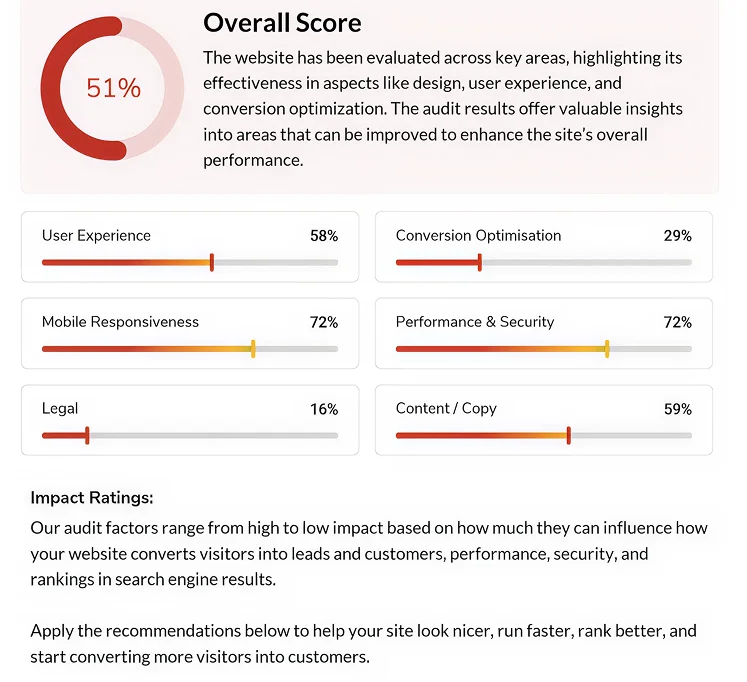
SEO metrics. We evaluate how your brand appears across ChatGPT, Google AIO, and Perplexity for the specific queries your customers are actually using. The audit produces a Visibility Score across six dimensions — and the results are often a wake-up call.
The audit above is a representative example. Notice that mobile responsiveness and performance score well — but conversion optimisation sits at 29% and legal compliance at 16%. These aren’t just website hygiene issues. To an AI model assessing trustworthiness, missing privacy policies and weak conversion signals are red flags that suppress citation likelihood.
“You’ve just read what it takes to get cited by AI. Now find out exactly
where your business stands today — and what’s standing in the way.”
Content Strategy: Building Topical Authority Over Time
AI models don’t cite brands that showed up once with a great piece of content. They cite brands that have demonstrated consistent, reliable expertise across a topic over time.
This is what we call Topical Authority — and it’s built through a disciplined, long-term content strategy.
Our approach for clients targets one high-quality post per month, typically 500–700 words, structured specifically for AI consumption: clear headings, factual claims, original data or perspective, and a semantic cluster of related terms. Over twelve months, this builds a body of work that AI models recognise as a credible source.
The key differentiator is Information Gain — providing a perspective, data point, or insight that doesn’t already exist on the first page of Google. AI models are specifically trained to surface novel, useful information. Repeating what everyone else says is the fastest way to be ignored.
Tracking GEO Performance in Google Analytics
One of the first things we do for clients is set up a dedicated GEO channel inside
Google Analytics 4 — a filter that separates traffic arriving from AI platforms (ChatGPT, Perplexity, Google AIO referrals) from traditional organic search. This makes AI-driven visibility measurable in the same language as the rest of your marketing: sessions, conversions, new users, engagement rate.
Without this channel, most businesses have no idea whether their GEO investment is working. With it, the ROI becomes as traceable as any paid campaign.
FAQs
How is GEO different from SEO — do I need both?
Yes. SEO gets you ranked on Google’s blue links; GEO gets you cited inside AI-generated answers. As AI Overviews capture an increasing share of search real estate, businesses that only invest in SEO will find their visibility eroding. The two disciplines overlap — strong structured data and authoritative content serve both — but GEO requires additional layers of strategy.
Does NAP consistency really affect ChatGPT recommendations?
Yes. Large language models build their understanding of local businesses from aggregated web data, including directories, review platforms, and citations. Inconsistent NAP data creates conflicting signals that reduce entity trust — the AI’s confidence that it knows who you are and where you are. Lower entity trust means lower citation likelihood.
What is Information Gain and why does it matter?
Information Gain refers to providing a perspective, finding, or data point that isn’t already represented on the first page of Google. AI models are trained to surface useful, novel information. Content that simply repeats established positions provides no incremental value to the model — and is therefore less likely to be cited. Original insight is now a competitive advantage, not just a nice-to-have.
How long does it take to see results from a GEO strategy?
A: Early technical wins — schema validation, structured data corrections, NAP consistency — typically show measurable impact within 2 -4 weeks. Citation frequency and topical authority build progressively from there, with most businesses seeing consistent AI citation patterns emerge within 60-90 days. Unlike traditional SEO’s 6-12 month timeline, GEO rewards
technical clarity fast — the businesses that start now build a structural advantage that’s difficult for late movers to close.
Find Out Where Your Brand Stands
Our AI Visibility Audit gives you a definitive score across six dimensions — and a clear action plan to improve it. If your competitors are already being cited by ChatGPT and you’re not, every day matters.