Can ChatGPT do SEO for South African Businesses?
ChatGPT is a powerful assistant for brainstorming, drafting, and research, but it cannot execute a complete SEO strategy on its own.
AI-generated content still needs human expertise, keyword intent alignment, and technical site health to rank in Google.
ChatGPT cannot fix slow page speed, broken site architecture, or missing structured data, all of which are critical for organic visibility.
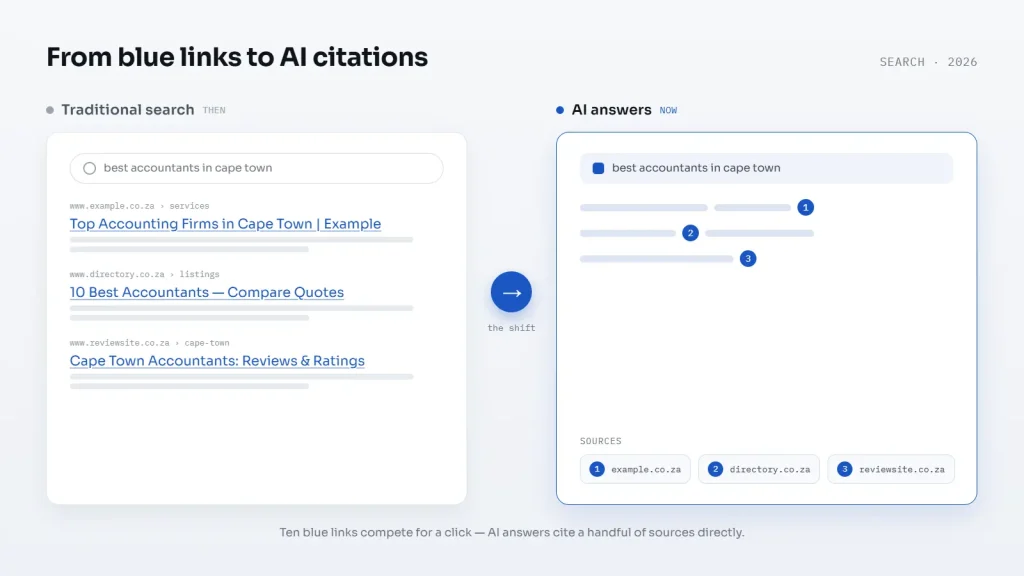
Strong traditional SEO signals remain the best way to earn mentions in AI search results, including ChatGPT’s own browsing mode.
Professional SEO combines AI efficiency with deep technical audits, original content, and ongoing optimization, a mix that no single tool can replace
The Short Answer: No, ChatGPT cannot execute a complete SEO strategy on its own. While it is a powerful assistant for brainstorming and drafting, it cannot fix technical site health, local South African mobile-speed issues, or missing structured data. In 2026, the real question isn’t whether ChatGPT can do your SEO, but whether your brand is optimized to be recommended by ChatGPT.
South African search interest for “can ChatGPT do SEO” has skyrocketed as local founders and corporate CMOs look for cheaper ways to grow organic traffic. The hard truth? Trying to prompt your way to Page 1 in Cape Town or Johannesburg will cost you revenue.
The tool is brilliant for execution, but treating it as a replacement for technical strategy and local market expertise is a costly mistake. Here is exactly what AI can actually handle, where it falls short, and how to dominate search in 2026 using Generative Engine Optimization (GEO).
Can ChatGPT do keyword research?
Yes, ChatGPT can assist with keyword research, but it cannot replace dedicated SEO tools or human judgment. You can ask it to generate seed keyword lists, group terms by intent, or suggest long-tail variations. However, it does not provide search volume, keyword difficulty, or competitive density data. Those numbers come from platforms like Google Keyword Planner, Ahrefs, or Semrush. Without them, you are guessing. I always validate any AI-generated keyword list against real metrics before building a content plan. The tool is a starting point, not the final answer.
Can ChatGPT write SEO content that ranks?
It can produce drafts, but ranking content requires far more than what a generic prompt delivers. ChatGPT often writes text that is grammatically correct but shallow, repetitive, and disconnected from the specific search intent behind a query.
Google’s guidance on creating helpful, reliable, people-first content makes it clear that content should demonstrate first-hand expertise and a depth of knowledge that AI alone cannot fabricate. I have audited sites where every blog post was AI-generated without human editing. They ranked for nothing. When we rewrote those pages with original insights, added FAQs, and structured the content around real user questions, rankings followed. The difference was substance, not just word count.
Can ChatGPT handle technical SEO?
No. ChatGPT cannot crawl your site, identify broken links, compress images, fix slow server response times, or implement structured data. Technical SEO is the foundation of organic visibility. If search engines cannot efficiently crawl and index your pages, no amount of AI-written content will save your rankings. I frequently run deep-dive technical audits that uncover issues like missing meta tags, oversized images, duplicate content, and poor mobile performance. These are problems that require developer-level fixes and ongoing monitoring. ChatGPT can suggest what a robots.txt file should look like, but it cannot diagnose why your actual crawl budget is wasted on parameter-heavy URLs. That takes a trained eye and real access to your site’s backend.
Can ChatGPT optimize for AI search and LLMs?
Yes, but only indirectly. ChatGPT’s browsing mode and other AI search platforms tend to surface content that already performs well in traditional search engines. A recent study found a strong correlation between high Google rankings and brand mentions in ChatGPT’s responses. In other words, the same signals that help you rank in Google, including crawlable links, clear page structure, and authoritative backlinks, also improve your chances of being cited by AI. OpenAI’s own SearchGPT prototype announcement emphasizes that they prioritize clear, attributable sources. That means brands need clean, well-structured content and strong third-party credibility. Our AI SEO service addresses this directly by optimizing both traditional search presence and AI discoverability, but the work still starts with fundamentals like crawlable URLs and structured data.

Where ChatGPT falls short for real SEO
The biggest gap is strategy. SEO is not a series of disconnected tasks, it is a continuous process that connects technical health, content authority, user experience, and competitive positioning. ChatGPT cannot analyze your competitor’s backlink profile, identify a gap in your site architecture, or decide whether a service page needs a full rewrite based on conversion data. It also cannot execute. Even if it generates a perfect meta description, someone still needs to implement it, test it, and monitor performance over time.
Another critical shortcoming is originality. AI models produce text by predicting the next most probable word. That leads to content that sounds like everything else already published. For competitive industries, that is a recipe for invisibility. Google’s systems are designed to reward original, high-quality content that provides unique value. A generic AI blog post does not meet that bar. I have seen clients with well-designed websites and decent domain authority fail to rank simply because their content was indistinguishable from dozens of competitors saying the same thing in the same way.
Finally, ChatGPT cannot handle the messy reality of most websites. I have inherited projects with years of plugin bloat, broken redirect chains, and Google Analytics tracking that was never properly configured. These issues distort traffic data and block organic growth before content even enters the picture. No AI prompt fixes a corrupted Google Search Console property or a site migration gone wrong. That requires a hands-on technical SEO professional.
How I use AI tools in a professional SEO workflow
I use ChatGPT and similar tools daily, but as accelerators, not replacements. For example, when a client’s website needed a full content refresh, I used AI to generate a first draft of FAQs and to help brainstorm semantically related topics. Then I rewrote every section with industry-specific knowledge, added original examples from the client’s actual work, and structured the headings to match search intent. The result was content that sounded human, answered real questions, and earned 13 page-one keywords in 90 days.
AI is also useful for prompt engineering in our seo services We build custom prompts for specific content types, but every output goes through a human editor who verifies facts, adjusts tone, and ensures the content aligns with the brand’s voice. This hybrid approach gives us speed without sacrificing the expertise that search engines and users demand.
For technical tasks, I do not rely on AI at all. Site speed optimization, image conversion to WebP, and schema markup implementation are manual processes backed by audit data. The ai search visibility audit I deliver to new prospects is built from real crawls and log analysis, not a ChatGPT summary. That diagnostic work is what turns a struggling site into a platform that can actually support ranking content.
What a real SEO strategy looks like (with or without AI)
A complete SEO strategy includes several interconnected workstreams. The table below contrasts a typical AI-only approach with what a professional SEO engagement actually delivers.
SEO component | AI-only approach | Professional SEO with Local Hero Digital |
|---|---|---|
Keyword research | Prompt-generated list without volume or difficulty data | Data-backed keyword mapping tied to business goals and search intent |
Content creation | Generic AI drafts with no original expertise | Human-edited, brand-specific content with original insights and structured FAQs |
Technical optimization | None (AI cannot crawl or fix site issues) | Deep-dive audits, speed fixes, schema implementation, crawl budget optimization |
Competitor analysis | Surface-level summaries from public data | Ongoing competitor intelligence, backlink gap analysis, and authority building |
Local SEO & GBP | No direct execution capability | Google Business Profile optimization, local citation management, and review strategy |
Ongoing monitoring | None | Monthly reporting, rank tracking, and iterative content updates |
AI search visibility | Hopes that AI will cite the site | Structured data, brand signal building, and content engineered for AI discoverability |
Frequently asked questions
Can ChatGPT replace an SEO expert?
No. ChatGPT can assist with specific tasks like drafting or brainstorming, but it cannot audit a website, build a custom strategy, or execute technical fixes. An SEO expert brings judgment, experience, and accountability that no AI tool currently offers.
Does ChatGPT help with local SEO?
It can generate ideas for local content or suggest Google Business Profile categories, but it cannot optimize your profile, manage reviews, or build local citations. Local SEO requires hands-on work with location-specific signals that ChatGPT cannot directly influence.
Will Google penalize AI-written content?
Google does not penalize content simply because it was written by AI. However, content that is unhelpful, unoriginal, or created primarily to manipulate rankings violates Google’s guidelines. The key is whether the content demonstrates real expertise and serves the user’s intent.
Can I use ChatGPT to generate meta descriptions?
Yes, but you should always review and customize them. ChatGPT can produce a solid first draft, but effective meta descriptions must include the target keyword naturally and accurately reflect the page’s content. Generic AI descriptions often miss the specific value proposition that drives clicks.
How do I get my site mentioned in ChatGPT answers?
Focus on earning strong traditional search rankings, building credible backlinks, and structuring your content with clear, factual information. ChatGPT’s browsing mode tends to cite sources that already perform well in Google and have a reputation for authority. There is no shortcut to prompting your way into AI citations.