1. The Mistake — Chasing Citation Before Crawlability
Most businesses trying to get visible on ChatGPT start with content: writing articles, adding FAQs, hoping the right phrasing gets picked up. Some go a step further and run a free visibility check — asking ChatGPT directly whether it knows them.
Both skip the same question: can the AI's crawler actually reach the site in the first place?
A free check tests the output — are we being mentioned. It says nothing about the input — can GPTBot, PerplexityBot and ClaudeBot get in, render the page, and extract something worth citing. A business can write excellent content and still be invisible, because the crawler never saw it.
2. What "Technically Flawed" Actually Means for AI Crawlers
This is what the technical layer of an audit is actually checking — not abstract SEO housekeeping, but the specific things that determine whether an AI crawler can use your site at all.
- Bot access — Whether GPTBot, PerplexityBot, ClaudeBot and OAI-SearchBot are allowed in robots.txt, and whether a firewall or security plugin is silently blocking them anyway, regardless of what robots.txt says. The single most common invisible blocker.
- JavaScript rendering — Most AI crawlers don't execute JavaScript like a browser does. Content inside tabs, accordions or lazy-loaded sections built with page builders can be a fraction of what a human visitor sees.
- Thin or shallow pages — AI answers are built from passages, not pages. A page under roughly 500 words rarely has enough substance to be the passage an AI model chooses to cite.
- Structured data — Organization, LocalBusiness, Service and FAQ schema formally assert who you are and what you do, instead of leaving an AI model to infer it from prose.
- Internal linking & crawl depth — Burying important pages several clicks from the homepage, or under-linking them versus blog content, signals — to Google and AI crawlers alike — that they matter less than they do.
None of this is exotic. It's the same handful of checks that should run before a single word of "GEO content" gets written — because content built on a broken foundation doesn't get seen, no matter how well it answers the question.
3. What the Audit Actually Checks — Foundation First
The full AI Search Visibility & GEO Audit runs 8 modules, reordered here by what actually has to come first.
| Order | Module |
|---|---|
| 1 | Technical & Crawlability Audit — can AI crawlers reach and read the site at all |
| 2 | Structured Data & Schema Review — does the site formally assert who you are |
| 3 | Knowledge Graph & Entity Mapping — do AI models understand you as a distinct business |
| 4 | LLM Content Gap Diagnostics — which buyer questions have no page built to answer them |
| 5 | Conversational Intent Match — does content match how people actually ask AI, not Google |
| 6 | Competitive Citation Share Analysis — who's being cited instead of you, and why |
| 7 | Digital PR & Backlink Signal Check — do outside sources corroborate your claims |
| 8 | Actionable GEO Roadmap — a sequenced plan, foundation fixes first |
The first two modules are the ones that make everything after them worth doing. Content strategy and digital PR built on top of a site AI crawlers can't properly read is effort spent on a foundation that isn't there yet.
4. What It Costs, and Why
FAQs
Why check crawlability before content strategy?
Because content an AI crawler can't fully see or trust can't be cited, regardless of quality. Fixing access and structure first means every piece of content built afterward actually has a chance to be read.
Is this different from a normal technical SEO audit?
It includes the same crawlability, indexability and structural checks as a traditional technical SEO audit, plus the AI-specific layer on top — bot-specific access, structured data built for LLM extraction, and content-gap analysis against how people actually query AI models.
Will fixing technical issues alone get me cited by ChatGPT?
No — it removes the blockers. Citation still depends on having content worth citing. But without a solid technical foundation, even excellent content may never be seen by AI crawlers in the first place.
Do I have to sign a retainer?
No. Fixed-scope, once-off engagement at R4,500. You keep the full roadmap regardless of whether you continue with Local Hero Digital afterward.
See the full 8-module audit, starting with your technical foundation
View the AI Search Visibility & GEO Audit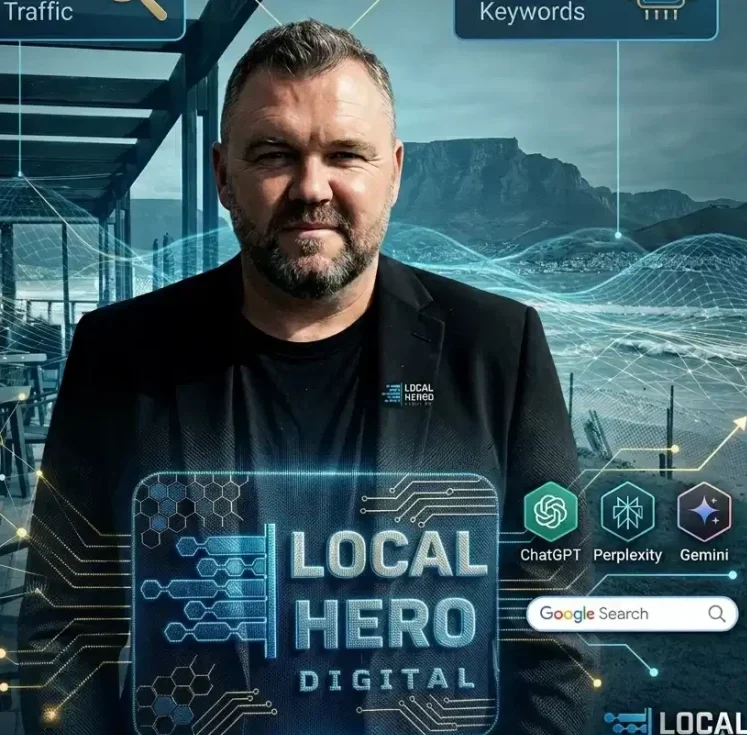
Kevin Kyle is a self-taught SEO specialist and the founder of Local Hero Digital, a Cape Town agency specialising in generative engine optimisation — getting South African businesses cited in ChatGPT, Google AI Overviews, Perplexity and Gemini. Eleven years in media, six in traditional out-of-home and five in digital. He runs every audit and retainer personally.