
1. The Data, As It Actually Is
We pulled our own 28-day Search Console export before writing this, rather than making the point with a hypothetical. Some of what we found:
| Query | Position | Impressions | Clicks |
|---|---|---|---|
| local seo cape town | 7.25 | 405 | 0 |
| perplexity ranking optimisation experts in cape town | 5.93 | 87 | 0 |
| local seo services cape town | 4.38 | 85 | 0 |
| ai seo services cape town | 4.19 | 80 | 0 |
| google ai ranking boost provider near me | 5.66 | 77 | 0 |
Across 113 queries like these, ranking anywhere from position 1 to 10, we've collected 2,014 impressions and exactly zero clicks — and that's a floor, not a ceiling, since Search Console quietly drops very low-volume queries from this table for privacy reasons. If you only ever looked at "average position" as your scoreboard, this would look like a win. It isn't one — impressions and rankings aren't revenue, clicks are, and clicks are the one number missing from every row above.
2. Why Ranking Well Doesn't Guarantee a Single Click
Three things are almost always behind this pattern, and they compound each other.
Nobody recognises the brand
When someone scans a page of results, a name they don't know competes against names they do — even at position 3, an unfamiliar agency is easy to scroll past in favour of something that already sounds familiar. In our own data, branded search — people searching "Local Hero Digital" by name — sits at just 8 impressions across the entire 28-day period. Visibility exists. Recall doesn't. That gap is what turns a good ranking into an ignored one.
A meaningful share of "impressions" may not be human at all
This is the uncomfortable one, and most agencies won't say it about their own numbers: around 1 in 10 of our impressions come from outside South Africa entirely, including unusually long, templated-sounding queries ("perplexity visibility optimisation providers in johannesburg") and hits from countries with no plausible connection to a Cape Town search — Papua New Guinea, Mongolia, Laos. That pattern lines up with Google's own AI Mode query fan-out and with AI visibility tracking tools probing the same terms automatically. It means the real, addressable human audience behind an impressions count is a little smaller than the headline number suggests.
The result doesn't directly answer the question
A title and meta description that describe a company ("AI Search Visibility Agency | Nationwide") don't do the same job as one that answers the exact thing someone typed. Google and AI models increasingly reward — and click through to — results that look like an immediate answer, not a company pitch.
3. Check Your Own Search Console in 5 Minutes
You don't need our audit to see whether this is happening to you — this part is free, and worth doing before you read any further.
- Open Google Search Console → Performance → Search results.
- Set the date range to the last 28 days, and tick Average position on top of the default Clicks/Impressions view.
- Sort the query table by Position, ascending.
- Scroll through the queries sitting between position 1 and 10 — and look specifically at the Clicks column next to them.
- Any query with a strong position and zero clicks is the exact pattern above, sitting in your own data.
If you find a handful, that's normal — check the meta title and description for the page ranking there, and honestly ask whether it reads like an answer or a pitch. If you find dozens, it's usually a structural issue worth diagnosing properly rather than fixing one title tag at a time.
4. What Actually Fixes This
Metadata rewrites help — matching a title and description to how people actually phrase the question closes some of this gap on its own. But the deeper fix is the same one behind everything else on this site: making sure the technical foundation, schema, and content structure are actually built to be trusted and cited, not just ranked. Position without trust gets you exactly the pattern above.
FAQs
Is this pattern normal, or is something broken?
Some of it is normal — no site converts every impression into a click. But a large cluster of top-10, zero-click queries usually points to a specific, fixable cause: weak brand recognition, metadata that doesn't answer the question, or content that isn't structured the way people actually search.
Should I be worried about the non-human impressions?
Not worried — just realistic. It means the real opportunity behind a big impressions number is often smaller than it looks, which matters for planning, not for panic.
Does fixing metadata alone solve this?
It closes part of the gap, particularly for pages already ranking well. It won't fix the underlying trust and structure issues covered in our Technical SEO Foundation piece — the two work together.
The gap above isn't proof that AI visibility doesn't convert — it's proof of how much more there is to capture once the underlying pattern is fixed.
See exactly what's behind your own rankings
Get the AI Search Visibility & GEO Audit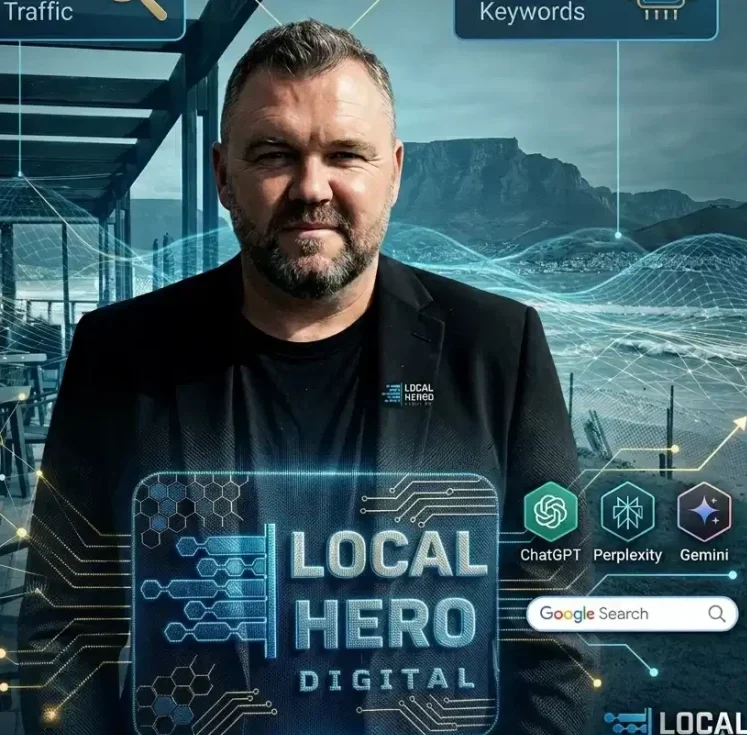
Kevin Kyle is a self-taught SEO specialist and the founder of Local Hero Digital, a Cape Town agency specialising in generative engine optimisation — getting South African businesses cited in ChatGPT, Google AI Overviews, Perplexity and Gemini. Eleven years in media, six in traditional out-of-home and five in digital. He runs every audit and retainer personally.